OEM & ODM Guides
Can You Use a Water Flosser Every Day? The Design Decides More Than the Answer
Daily use is usually discussed as a question about people. It is at least as much a question about the product: tank, charge, routine and cleaning decide whether it lasts.
Quick answer
“Can I use this every day?” is one of the first questions a customer asks, and it is usually answered as though it were a question about people. In practice it is at least as much a question about the product.
A water flosser that is designed around a daily routine will be used daily. One that is designed around a weekly routine — a tank that needs refilling mid-session, a charge that does not survive a week, a cleaning routine nobody would repeat — will sit in a drawer, and no amount of instruction on the box will change that.
There is a second half to the question that a manufacturer cannot answer. Whether a specific person should use any oral care device, how often, and at what setting, depends on their mouth and their dental history. That part belongs to their dental professional, and the useful thing a brand can do is say so clearly once, rather than attempt an answer.
This article covers the first half: the six design details that decide whether daily use feels natural, the figures worth confirming before you promise a routine on the box, and a checklist to run before packaging.
1. Daily use is a duration question before it is anything else
The most useful way to think about daily use is in fill cycles, because that is the unit a customer experiences.
A routine that fits inside one tank feels like a habit. A routine that needs a second fill in the middle feels like a chore, and chores get skipped. This is not a matter of discipline; it is the ordinary arithmetic of how people behave with small frictions.
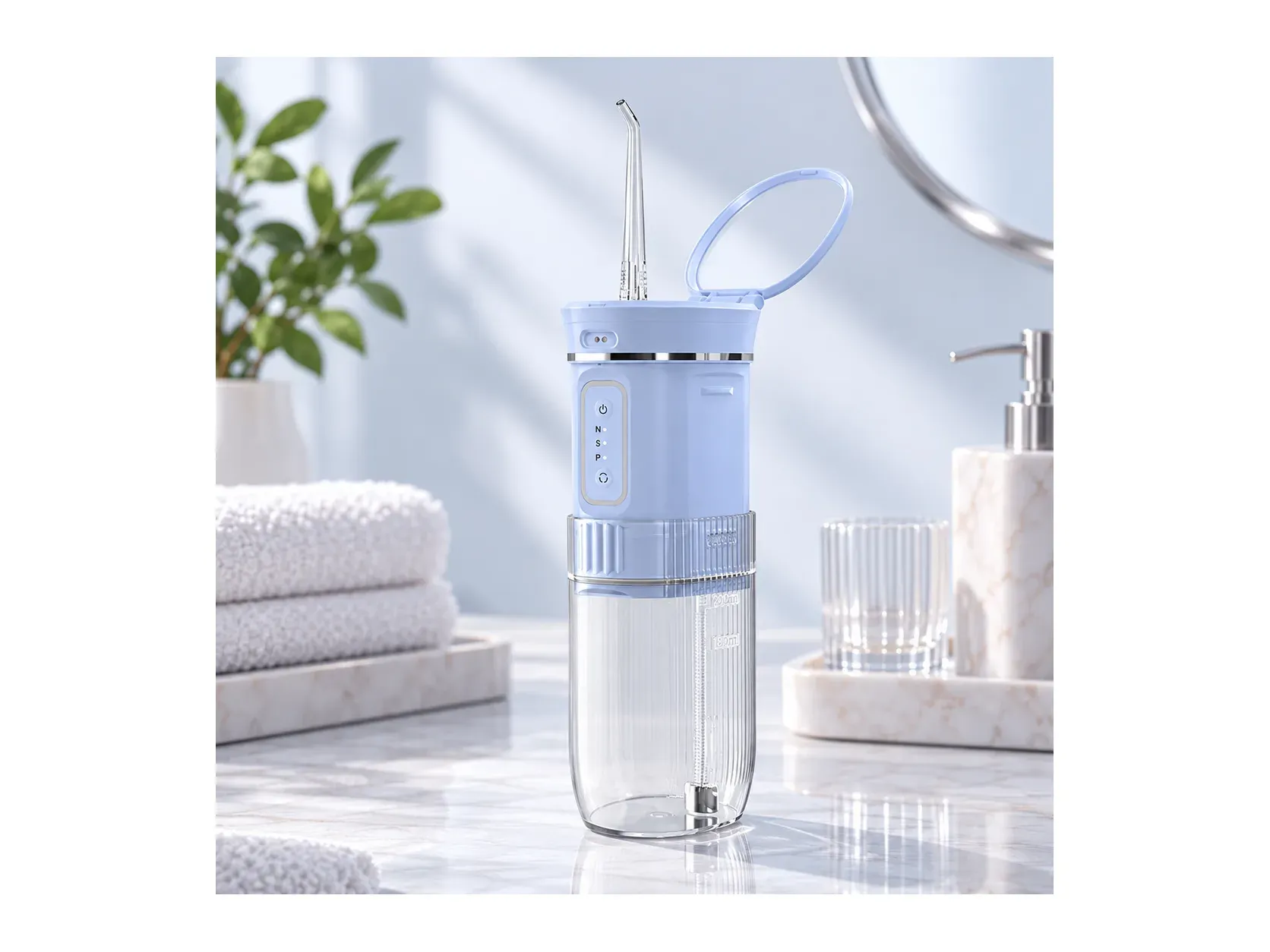
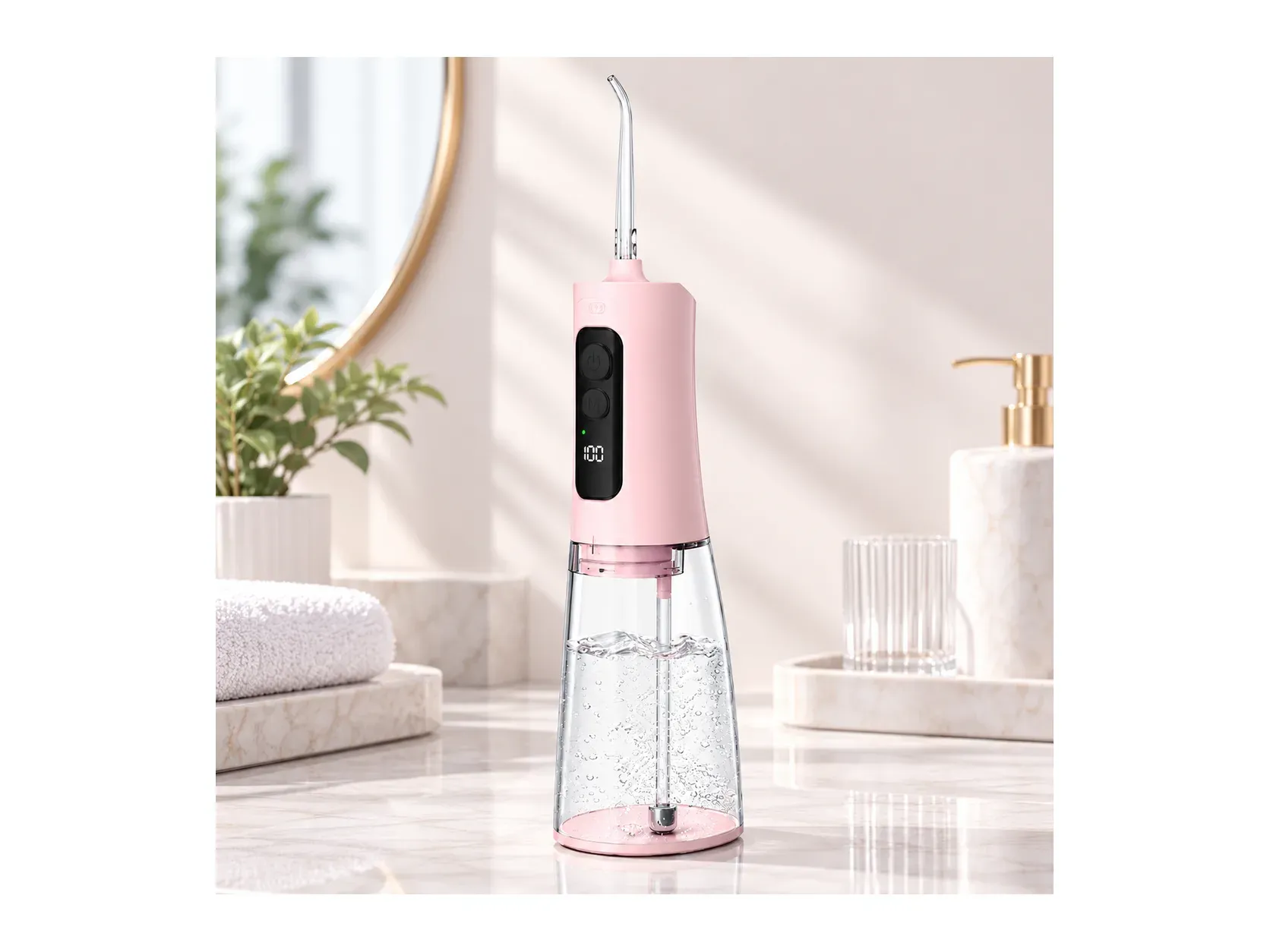
Our countertop unit carries a 320 ml tank, and the specification states what that actually buys: at the highest level a full tank lasts about one minute twenty-eight seconds, and at level 40 about one minute fifty seconds. A compact unit with a 200 ml tank has a shorter window by design.
Both figures are honest and neither is a criticism. What matters for a brand is that the number is on the specification sheet before the phrase “full routine” goes on the box. A one-minute window is a complete routine for some customers and half a routine for others.
2. The tank is a placement decision, not a size contest
Tank size gets discussed as though bigger were better. What it actually decides is where the product lives.
A 320 ml tank supports a session at a basin edge without a second fill, and it comes with a body 219 mm tall. A 200 ml tank with a pull-out reservoir fits in a wash bag and gives up some session length. The two trade-offs are equally legitimate, and they point at different customers.
There is a detail here that rarely appears on a product page: how the tank is filled. A side inlet allows a refill without dismantling the unit, which matters on the third use of the day. A top inlet usually means removing the reservoir, and every removal is a small chance to spill, mis-seat it, or skip the refill and stop early.
In our experience this single detail predicts daily use more reliably than tank volume, because it is the step that gets repeated. It is worth asking about specifically, and worth stating on the box if the answer is favourable.
3. Charging decides whether it is ready when the habit happens
A device that needs charging during the week has a scheduling problem, and scheduling problems break habits.
The relevant figures are not impressive ones. Charge time, battery capacity, and what the unit does when it is left alone matter more than a headline number that sounds large.
Both of our water flossers carry a 1200 mAh battery. The countertop unit charges in about two and a half hours, and the countertop unit also powers itself down after two minutes idle rather than waiting to be switched off — which removes one small way for a daily device to lose charge in a drawer. The compact unit is specified at roughly ninety minutes of runtime per charge.
For a brand, the practical check is simple: does the specification sheet state a charge time and a battery capacity in figures you can verify? A model that states neither leaves you with nothing to print on the box, and nothing to answer a customer who asks how long the battery lasts.
4. Memory and preset design decide how many decisions a day costs
Daily use accumulates decisions. A device that makes a customer choose a setting every single time charges a small tax on every use.
This is where a wide adjustable range can work for or against a product. The countertop model offers 1–100 stepless levels with quick presets at 20, 40, 60, 80 and 100, and it returns to the last level and mode used. The compact model takes the other route: three fixed modes and a shorter routine, which removes the decision by removing the choice.
Neither is superior. The distinction worth knowing is that level count and daily friction are different variables. A hundred levels with memory is a low-friction device. A hundred levels without memory is a device that asks the customer to find their setting every morning — and that is the version customers stop using.
We tend to think memory is the single most under-specified feature in this category, because it does not appear in a photograph and cannot be counted.
5. Cleaning is what keeps it in use past the first month
The device that gets used every day is the one that is quick to clean. This sounds like a footnote and behaves like the main character.
A cleaning routine that takes under a minute gets done. One that requires disassembly mostly does not, and a routine that is not done does not protect anything, however well the parts are designed.
Three places collect residue in any water flosser: the tank, the base of the nozzle, and the joint where the nozzle seats into the handle. All three are decided at the design stage, and none of them appear in a specification.
For a private-label brand, the useful instruction to request is one that can be performed with the unit assembled: rinse the tank, run warm water through an empty unit until it drains, dry the nozzle base, store the tank open. If the instruction your supplier provides requires taking the unit apart, it will not be followed, and the complaints will arrive in month four rather than week one.
6. Where the frequency question stops being a product question
At some point the question “can I use this every day” stops being about the design and becomes about a person, and it is worth being clear where that line sits.
A manufacturer can describe how the device works, how a routine is performed, how the settings move from low to high, and how the unit is cleaned. Those are operational facts about a product.
What a manufacturer cannot do is tell an individual how often to use it, whether a particular condition changes the answer, or what to do around a dental treatment. Those answers depend on a mouth and a history that no specification contains. The safe and useful thing a brand can print is a single general line directing customers with a specific condition or a recent treatment to their dental professional before first use.
This is not evasion. A brand that answers the question concretely is making a claim it cannot support once the product leaves the warehouse, and the exposure arrives with the shipment rather than with the writing.
7. A daily-use readiness checklist
The list below is what we run through with a brand before “daily use” appears anywhere in the marketing. Every item is answerable from a specification sheet or a sample, which is what makes it useful.
1. Full-tank duration is stated in figures, at a named setting, on the specification sheet.
2. A single fill covers the routine you intend to describe on the box.
3. The tank can be refilled without dismantling the unit, or the manual explains the refill clearly.
4. Charge time and battery capacity are both stated in figures.
5. The unit returns to its last level and mode, or the mode count is small enough that this does not matter.
6. There is an idle shut-off, and its duration is stated.
7. The cleaning routine can be performed assembled and takes under a minute.
8. A single general line directs customers with a specific condition or recent treatment to their dental professional.
9. The routine described on the box matches the duration the tank actually supports.
Item nine is the one that most often fails, and it fails quietly. A box that promises a routine, and a tank that delivers one minute twenty-eight seconds at the top setting, can both be accurate and still describe different experiences. Confirming the pairing before artwork is much cheaper than correcting it after a print run.
Frequently asked questions
Is daily use realistic for most customers?
It depends on the routine the product was designed for. A device with a tank that covers one session, a charge that survives a week and a cleaning routine under a minute is set up for daily use. The same specification should be checked against the routine you intend to advertise, rather than assumed.
How long does one tank actually last?
On our countertop unit, about one minute twenty-eight seconds at the highest level and about one minute fifty seconds at level 40. The difference is the point: duration is a function of the setting, so a single number without a stated setting is not a specification.
Does a bigger tank mean a better product?
Not in general. A 320 ml tank supports a longer session at a basin; a 200 ml pull-out tank travels better. The two are answers to different customer routines, and the more useful question is which routine you are selling into.
How long does the battery last and how long does it take to charge?
Both of our water flossers carry a 1200 mAh battery. The countertop unit charges in about two and a half hours; the compact unit is specified at roughly ninety minutes of runtime per charge. A single run-time figure also depends on mode and level, so request the number for the setting your market will actually use rather than a headline figure.
What happens if a customer forgets to switch it off?
The countertop unit has a two-minute idle shut-off, so it powers down on its own. This is a small design detail that matters for a daily-use product, because a device that silently drains in a drawer loses the habit. Whether a given compact model includes the same behaviour is worth confirming on the specification before it goes into print.
Does the unit remember the last setting?
The countertop unit returns to the last level and mode used. The compact unit keeps a three-mode routine instead. Memory is not visible in a product photograph and does not appear on most specifications, so it is worth asking about explicitly.
Can we say on the box that it is suitable for daily use with braces or implants?
Describing an accessory as shaped for use around braces is a product description. Telling a specific group of patients how often to use it, or what it will do for their treatment, is advice that belongs to their dental professional. The safer pattern is to describe the accessory and add one general line directing customers with a specific condition to professional advice.
Will a lighter or quieter unit be used more often?
Weight and noise are reasonable proxies for comfort, and both are stated figures rather than impressions: our countertop unit is 259 g and the compact unit 274 g. Beyond that, in our experience the details that change daily use are the refill step, the charge cycle and the cleaning routine rather than the headline weight.
Next step
If you are preparing a daily-use claim for a private-label water flosser, the useful things to send are short: your target market, the routine you intend to describe on the box, your expected quantity and your launch timing. With those four, we can confirm which of the two configurations fits that routine, and which figures in the specification support the wording you are planning.
Both water flossers and their documented specifications are described on their product pages, and the contact details for a configuration conversation are on the contact page: contact our team.